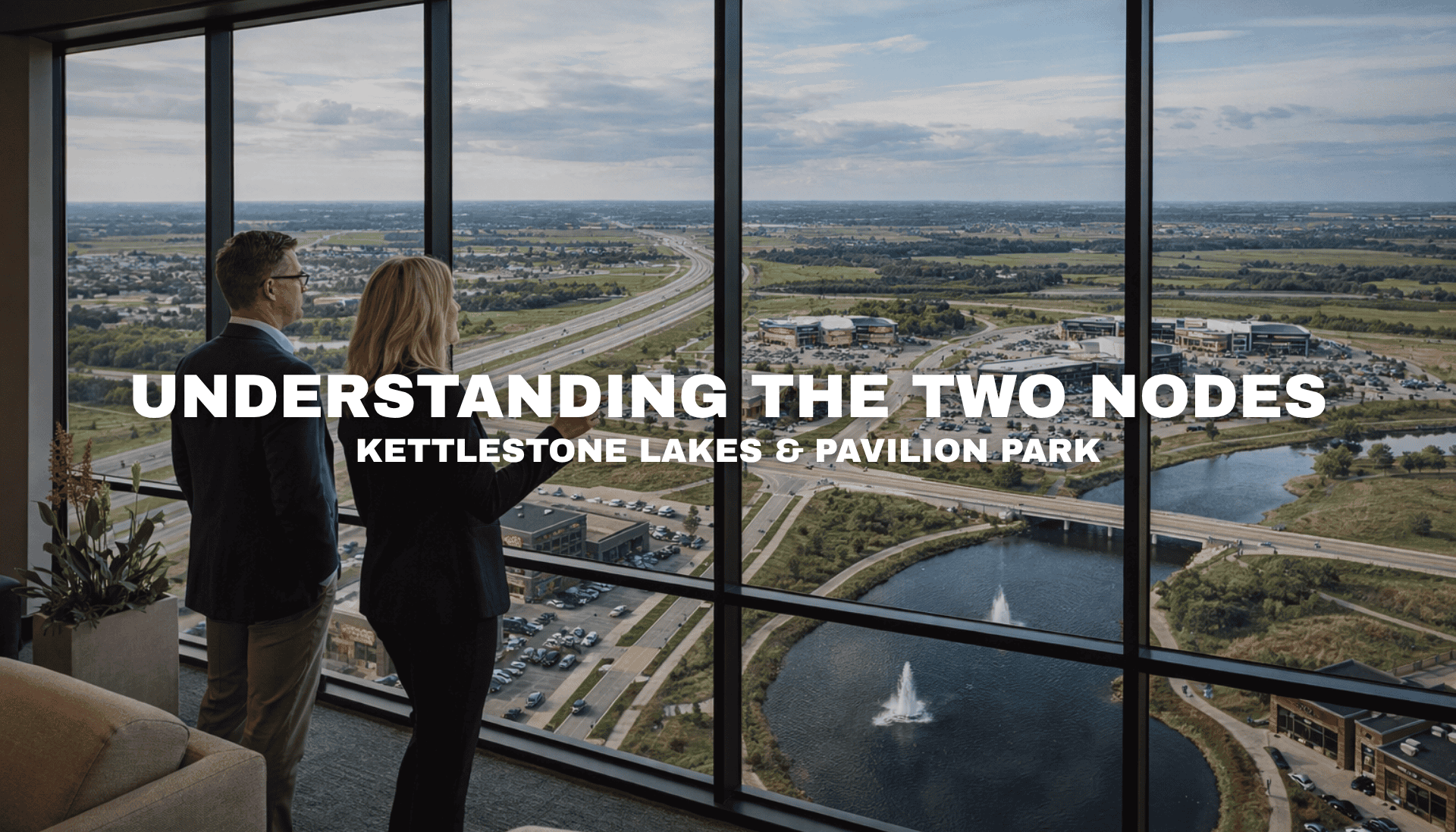
Two Nodes, One Strategy: How Kettlestone and Pavilion Park Work Together for Regional Tenants
In most markets, commercial developments compete.
In Dallas County, two of the most strategic sites — Kettlestone Lakes in Waukee and Pavilion Park in West Des Moines — do something different:
They complement each other.
Together, they form a dual-node commercial strategy along the Grand Prairie Parkway and I-80 corridor — one capturing community-driven demand, the other capturing regional and interstate traffic.
For tenants, developers, and investors, this creates a powerful opportunity to think beyond a single location — and instead position across an entire growth corridor.
Understanding the Two Nodes
Kettlestone Lakes: The Community Anchor
Kettlestone is built around:
- Residential growth
- Walkability and lifestyle
- Mixed-use integration
- Daily-use retail and services
It captures:
- Local families
- Nearby neighborhoods
- Students and community activity
- Repeat, routine-driven visits
This is where businesses build frequency.
Pavilion Park: The Regional Gateway
Pavilion Park, located just south along Grand Prairie Parkway near I-80, is built around:
- Interstate visibility
- Regional accessibility
- Corporate and hospitality demand
- High-traffic exposure
It captures:
- Interstate travelers
- Regional visitors
- Corporate users
- Destination-driven traffic
This is where businesses build reach.
One Corridor, Two Functions
Rather than competing for the same tenants, these two developments serve different roles within the same system.
Think of the corridor like this:
- Pavilion Park pulls people off I-80
- Grand Prairie Parkway moves them north
- Kettlestone Lakes captures them within the community
This creates a flow of traffic and activity that benefits both nodes.
For developers and tenants, it means:
- More consistent traffic patterns
- Broader customer bases
- Stronger long-term performance
Why Multi-Location Strategies Are Increasing
Many growing brands — especially in retail, dining, healthcare, and fitness — are no longer relying on a single location per market.
Instead, they are adopting cluster strategies:
- Multiple locations within the same corridor
- Different formats serving different audiences
- Brand reinforcement across geographic nodes
This is especially effective in high-growth suburban markets like Dallas County.
How Brands Can Use Both Locations Strategically
Example 1: Restaurant Group
- Pavilion Park location: captures interstate and destination dining traffic
- Kettlestone location: captures local repeat customers and community engagement
Example 2: Fitness or Wellness Brand
- Pavilion Park: high-visibility flagship location
- Kettlestone: neighborhood-focused studio with daily recurring visits
Example 3: Medical or Service Provider
- Pavilion Park: access for regional patients
- Kettlestone: convenient location for local families
Example 4: Retail Brand
- Pavilion Park: brand exposure and first-time discovery
- Kettlestone: repeat shopping and loyalty building
This dual-node approach increases market share without over-relying on a single site.
The Advantage of Corridor Dominance
When brands operate within both nodes, they gain something powerful:
Corridor dominance.
Instead of competing for visibility, they:
- Control multiple entry points into the market
- Capture customers at different stages of their journey
- Reinforce brand recognition through repetition
- Reduce reliance on a single trade area
This strategy is common in major metros — and is now emerging in suburban growth corridors like Waukee and West Des Moines.
Infrastructure Makes the Strategy Work
The success of a dual-node system depends on connectivity.
Grand Prairie Parkway provides:
- Direct north-south linkage between both sites
- Efficient traffic flow
- Visibility along a growing commercial corridor
I-80 provides:
- Regional access
- Interstate exposure
- Consistent traffic volume
Together, these create a unified commercial ecosystem — not isolated developments.
Why This Matters for Developers
Developers who understand the relationship between Kettlestone and Pavilion Park can:
- Position projects to complement, not compete
- Attract tenants with multi-site strategies
- Lease space faster with broader demand narratives
- Build within a coordinated growth corridor
Instead of marketing a single site, they are marketing an entire commercial network.
Long-Term Value Through Alignment
As Dallas County commercial expansion continues, the connection between these two nodes will strengthen.
More rooftops.
More traffic.
More business activity.
Developments that align with both local and regional demand patterns tend to outperform those that rely on only one.
Kettlestone and Pavilion Park together create:
- Stability through local demand
- Growth through regional exposure
- Flexibility through multiple positioning options
A Smarter Way to Enter the Market
For tenants and investors entering the Des Moines metro, the question is no longer:
“Which site is better?”
The better question is:
“How do these sites work together?”
Kettlestone Lakes and Pavilion Park offer a rare opportunity to build across a connected corridor — capturing both daily routine traffic and regional movement.
Two nodes.
One strategy.
One of the strongest commercial positioning opportunities in the market.